War, the Hero and the Will by Jane Bownas
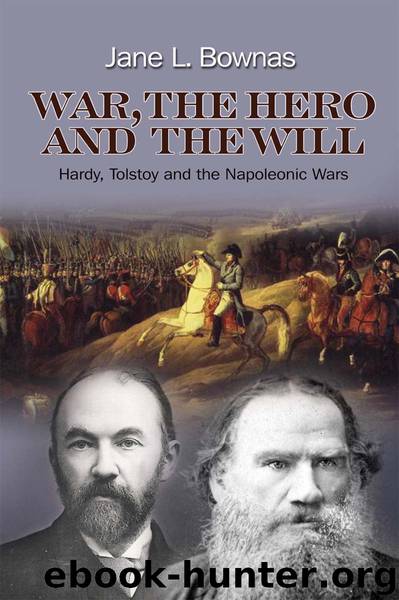
Author:Jane Bownas
Language: eng
Format: epub
Publisher: Sussex Academic Press
Published: 2015-03-14T16:00:00+00:00
The Hero as Great Man
Thomas Carlyle, an early proponent of the Great Man theory of history made no real distinction between a hero and an individual who because of their particular abilities and skills was able to influence the course of history. He maintains, ‘all things that we see standing accomplished in the world are properly the outer material result, the practical realization and embodiment, of Thoughts that dwelt in the Great Men sent into the world’.18 For Carlyle ‘the Hero can be Poet, Prophet, King, Priest or what you will, according to the kind of world he finds himself born into’,19 and so Shakespeare, Dante, Rousseau and Johnson are seen in the same light as Cromwell and Napoleon. He does admit that ‘The Commander over Men; he to whose will our wills are to be subordinated … may be reckoned the most important of Great Men. He is practically the summary for us of all the various figures of Heroism’.20 Marilyn Butler suggests that at the beginning of the nineteenth century ‘a taste was beginning to emerge to see the artist as a hero’,21 and the Romantic poets, who realised that their writing alone would be insufficient to change the course of history, transferred their hopes onto someone who by military means might be able to bring about change. Carlyle sees that initially Napoleon did act as a Great Man, taming the French Revolution, abhorring anarchy, carrying out brilliant campaigns in Italy, ‘through Wagrams, Austerlitzes; triumph after triumph, - he triumphed so far … he rose naturally to be the King. All men saw that he was such’. It is not surprising therefore that he ‘might seem to himself the greatest of all men that had been in the world for some ages’.22 Having conquered most of Europe he wanted to connect himself with the European Dynasties and found his own Dynasty. In Carlyle’s words ‘Self and false ambition had now become his god’.23
In The Dynasts Hardy displays this ambition in a poignant scene between Napoleon and his wife, Josephine who has not been able to provide him with a male heir. Napoleon harshly says,
There is, of course; that worm
Time ever keeps in hand for gnawing me!-
The question of my dynasty – which bites
Closer and closer as the years wheel on.
Josephine replies,
Nought recked you
Of throne-succession or dynastic lines
When gloriously engaged in Italy!
I was your fairy then; they labelled me
Your lady of Victories; and much I joyed,
Till dangerous ones drew near and daily sowed
These choking tares within your fecund brain.
Napoleon reveals his own selfishness by accusing Josephine,
And selfish ’tis in my good Josephine’
To blind her vision to the weal of France,
And this great Empire’s solidarity. (Dynasts, II, 2, vi, 200–01)
Twenty years before Carlyle delivered his lectures on Great Men, the German philosopher, Hegel delivered a series of lectures which was published as ‘The Philosophy of History’, and in which he describes World-Historical men who ‘may be called Heroes, inasmuch as they have derived their purposes and their vocation, not from
Download
This site does not store any files on its server. We only index and link to content provided by other sites. Please contact the content providers to delete copyright contents if any and email us, we'll remove relevant links or contents immediately.
Fanny Burney by Claire Harman(26607)
Empire of the Sikhs by Patwant Singh(23090)
Out of India by Michael Foss(16861)
Leonardo da Vinci by Walter Isaacson(13342)
Small Great Things by Jodi Picoult(7156)
The Six Wives Of Henry VIII (WOMEN IN HISTORY) by Fraser Antonia(5519)
The Wind in My Hair by Masih Alinejad(5104)
A Higher Loyalty: Truth, Lies, and Leadership by James Comey(4967)
The Crown by Robert Lacey(4821)
The Lonely City by Olivia Laing(4808)
Millionaire: The Philanderer, Gambler, and Duelist Who Invented Modern Finance by Janet Gleeson(4483)
The Iron Duke by The Iron Duke(4367)
Papillon (English) by Henri Charrière(4278)
Sticky Fingers by Joe Hagan(4208)
Joan of Arc by Mary Gordon(4119)
Alive: The Story of the Andes Survivors by Piers Paul Read(4037)
Stalin by Stephen Kotkin(3973)
Aleister Crowley: The Biography by Tobias Churton(3647)
Ants Among Elephants by Sujatha Gidla(3472)
